

Welcome to New Music + Old Music. If you like the posts & playlist streams and want to get ‘em all, consider a subscription. Thanks!
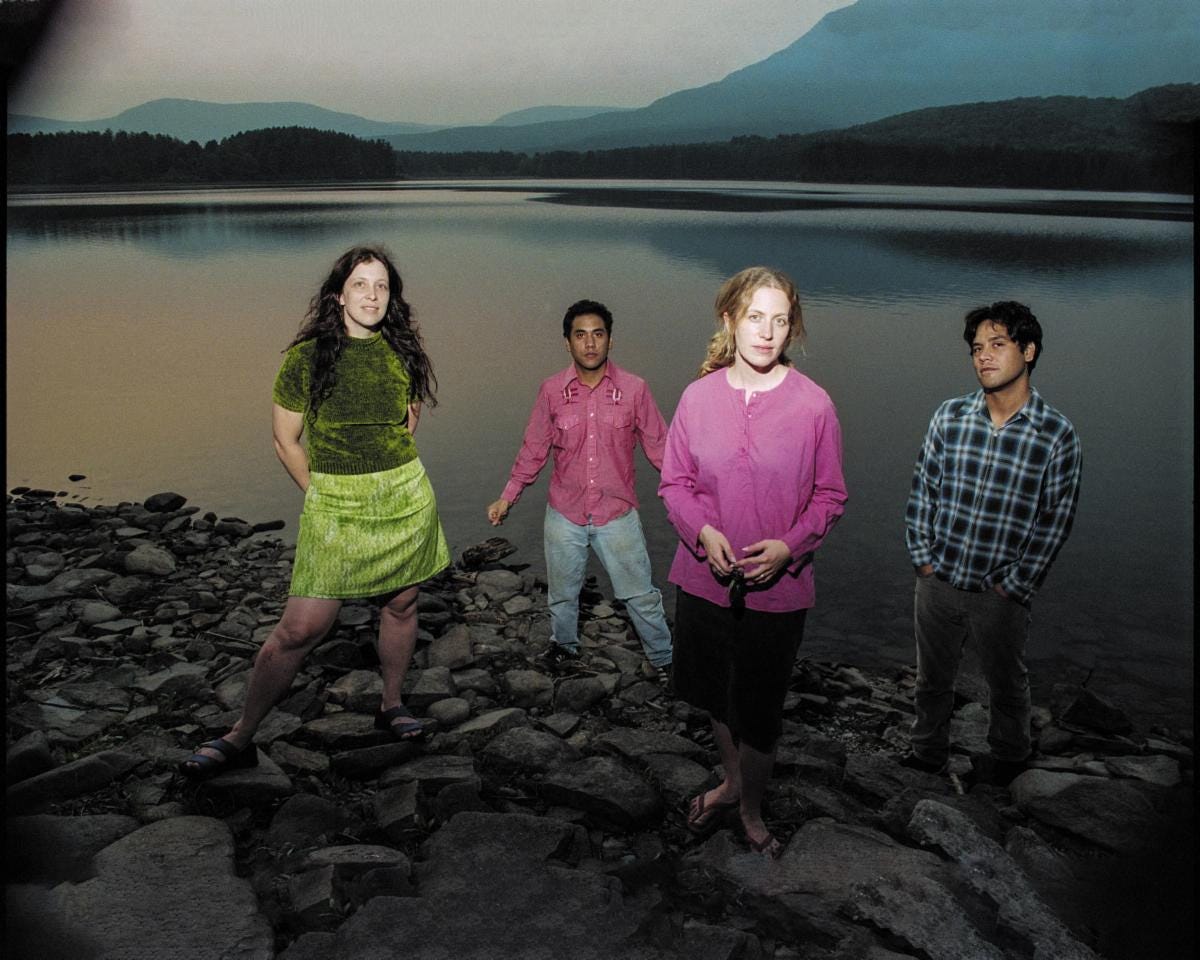
Just kids: Ida at the Ashokan Reservoir in New York, 1999. (l-r) Karla Schickele, Michael “Miggy” Littleton, Elizabeth Mitchell, Dan Littleton. Photo by Pat Graham.
Back in 2000, I reviewed Ida’s Will You Find Me for Entertainment Weekly — one of those mainstream U.S. print publications that paid arts & music writers decently, and helped a bunch of us make rent while honing skills. Most of the reviews were short, and EW (colloquially pronounced as the letters EW, not *ewww*) didn’t cover much indie music. But sometimes they did. They ceased publishing the print edition in 2022, though they still exist online in diminished form, like so many legacy magazines.
Here’s what I wrote in 2000:
Ida: Will You Find Me (Tiger Style)
Another small victim of major-label megastar fixation, the dreamy Brooklyn chamber-rock outfit Ida finally releases the CD Capitol financed but fumbled. Front-couple Daniel Littleton and (ex-Lisa Loeb partner) Elizabeth Mitchell have refined their slow-motion harmonies and guitar levitations with piquant melodies and textures, making music — like the maturing relationships their lyrics conjure — that's less about climax than about detailed foreplay. Will You Find Me is sad, pretty, hope-filled, exquisitely crafted, and utterly haunting. Grade: A
Nowadays I generally avoid the adjective “piquant,” and I’ve grown dubious of grading art (tho I still do it on occasion). Nevertheless, I stand by that review.
So it was with great pleasure that I received the news of Will You Find Me being reissued in a big fat box set, by the dedicated archivists of Numero Group, as Will You Find Me 25th Anniversary Edition.
Given the fact that Dan Littleton and Elizabeth Mitchell live in my neck of the woods, New York’s Hudson Valley, and have been deeply involved in the music scene here since relocating from Brooklyn shortly after this album was made, I figured I’d give them a holler.
We talked about music-making, and some of the legends they worked and/or rubbed shoulders with in this mythic region (including The Band’s Levon Helm). We also talked about community-building, past and present, and torch-passing. We didn’t talk per se about being in a long-term relationship and raising a kid while also making music together. But the conversation telegraphs a sense of that quite touchingly.
The box set is out April 25, and beginning this week, Ida is touring with Tsunami, their old pals and mentors (and now, once again, labelmates, with their own retrospective box set). They’ll all kick things off in Woodstock this Saturday, March 22, at Levon Helm Studios, fittingly, a place where they have plenty of history. This configuration of Ida — the original quartet, with Karla Schickele and Dan’s brother Michael — will also feature Liz & Dan’s daughter, singer-songwriter and multi-instrumentalist Storey Littleton.
Here’s the tour itinerary, followed by excerpts of our conversation. Enjoy! - Will
MARCH
22 – Woodstock, NY – Levon Helm Studios
23 – Somerville, MA – Crystal Ballroom
27 – Washington, DC – Black Cat
28 – Philadelphia, PA – Underground Arts
29 – New York, NY – Bowery Ballroom
APRIL
4 – Ferndale, MI – Magic Bag
5 – Chicago, IL – Lincoln Hall
18 – Seattle, WA – Tractor Tavern
19 – Portland, OR – Polaris Hall
23 – San Francisco, CA – The Chapel
25 – Los Angeles, CA – Lodge Room
WILL: Nice to speak with y’all! This album was a soundtrack for my partner and I when we first moved from Brooklyn up to the Woodstock area. And the music is kind of rooted in this region.
LIZ: We actually moved up here after we’d released it, in 2004. We'd been searching for a long time for a house. I guess we started looking in ‘99. I have family ties here, my Greek relatives. My grandmother grew up in Kingston, and all her sisters. I had a lot of country cousins here that I thought were really tough and intimidating; I always felt like they could beat me up! [laughs] They were so cool, and I was down in the suburbs. But I was always super drawn to the area.
WILL: Maybe the best way into the album is to ask about specific songs. “Past the Past” and “Georgia” are two of my favorites. Talk about those a bit.
DAN: I felt “Past the Past” was like one of those Pour Down Like Silver Richard and Linda Thompson songs. And it ended up having a little bit of that feeling of maybe a Sister Lover's Big Star-type song […] but we also kind of did it with a kind of caveman, Crazy Horse feel.
You never know where a song lyrically kicks off from. Even though that song wasn't in any way really about Mark Eitzel, we were friends, and I saw him outside of Maxwell's one night trying to hail a cab in the pouring rain. Sometimes something like that will spark an idea. I don’t know what to say about the song … I always felt like the trick of it for me was getting my beautiful life partner here to sing the word “nausea” really melodiously with me. [laughs]
LIZ: There must be more to say than that!
DAN: It's one of those more blunt, direct kind of Ida songs. They're not all that way. I think it gets at this feeling of being really shaken by somebody's loss of hope, and trying to find some way in when they're drifting too far out to sea. And there's a lot of ambivalence in the song, the lines “I care about what you see/ even though you try to take the best in me/ and punish me for trying.” There's ambivalence, but a lot of hope, and the feeling of wanting to help someone.
It emerged while my father was sick and we were taking care of him, in Annapolis [Maryland]. And it was a little bit [about] reconnecting to people that I came up with, people in bands that I'd been in that were really foundational. And just struggling with those kind of histories. When you go home, to your origin town, all that stuff creeps to the surface.
I've been thinking a lot about David Lynch's passing, and his films. We share a birthday; I'm a fan, and I'm revisiting some of his work. He had this unbelievably sunny, hopeful disposition: really funny, really charming. But at the same time, he essays darkness so thoroughly in his films. I feel like he was looking for something like at the end of “Past the Past,” there's a line: “Search your face for a spark/ for something shimmering in the dark.”
Sometimes it is in that darkness that you can really get clarity and really understand more about the nature of things that are luminous and hopeful. I'm sure there's a cliche to put it there — dark before the dawn or something like that. But I really feel like it’s important. We all have the darkness; it's kind of one of the inescapable parts of the human situation. But we also know light, and can't turn back from that.
LIZ: I don't know if we'll be playing it on tour, because Daniel doesn't like to play it live, I think because it's too easy to play.
DAN: I thought we were playing it. We did it the other day. It was great.
LIZ: Yeah, but you were resisting…
WILL: Uh-oh.
LIZ: [laughs] Let's play it on tour… Will likes it, right?
DAN: Well, the combination of what you just said—the shame—and then Will being down with the song, and leading the interview with questions about it … I feel like we might have to talk about it afterwards. [laughs] I thought it was really good — we stretched it out and Storey, our daughter, is playing with us, and she and I got into a kind of Television guitar thing — a little Richard Lloyd - Tom Verlaine duel with the kid. Which was really fun. So I actually thought we were doing it.
LIZ: Awesome. Good. Sealed.
WILL: Well okay then! Tell me about “Georgia.”
LIZ: While we were writing this album, I found out that my grandmother had a sister that we never knew about. She had three other sisters, and they were really close, so it was surprising to hear there was one missing. She had had epilepsy, but at the time, doctors didn't know how to treat epilepsy or really understand it. So she was sent away to an institution when she was, I guess, maybe nine or 10 years old, and then nobody spoke of her again. Her name was Georgia.
So my sisters and I became focused on this. We found where she'd been; we visited her grave in Western New York, by the Finger Lakes. I wrote the song to remember her, and keep her with the family, keep her presence alive.
Her sisters moved around a bit, but then the family settled in Kingston. And as a child, I'd visited the Ashokan Reservoir. My great uncle was the foreman; we’d go to barbecues there. There's all these family memories of this area, and I was thinking back to how she wasn't there for any of it. And then — it was such unexpected thing to be recording at Dreamland [Studios, a former Catholic church], and have my parents visit and say, “oh, we know this place. This is where your great aunt was married. We went to funerals here.” And we were recording the song there the day that my parents came to visit. Jerry Marotta [longtime Peter Gabriel drummer, former owner of Dreamland] returned to the studio last summer to remix some tracks that are on the reissue.
DAN: It was a really magical thing to see Liz's parents looking around and just realizing that they knew this place. I think it was one of those synchronistic kind of events that makes you feel like, okay, maybe we're in the right place at the right time.
LIZ: Writing that song also was a satisfying experience for me. I’d wanted to write a sort of country song, a bit different than how I'd been writing up until then. We were such deep fans of Gillian Welch at the time, so excited about what she was doing to get people in our generation more interested in playing music that way. I think she's such a lighthouse, musically, for so many. I just love her. We were also big Freakwater fans.
WILL: There are so many great covers in the box set — Dylan, The Beatles and Neil Young, but also country songs: Loretta Lynn, Dolly’s “The Pain of Loving You.” The old [Carter Family] song “Are You Tired of Me, My Darling?” So you were listening to that kind of music?
LIZ: Oh yeah. When Daniel and I first started dating, and he was coming from this punk rock world, and I was more from this singer-songwriter, acoustic pop thing with Lisa Loeb, old country music and Prince were the two things that we had in common.
DAN: And Joni Mitchell.
LIZ: Yes. But we didn't sing as much Joni, I'm just saying…
DAN: I’ve got tapes!
LIZ: [Laughs] Okay. So country music, Prince… and The Knitters. They were punks doing country, which was just like heaven.
DAN: We didn't pick up on the Mekons until a little later. We weren't that smart yet. Lucinda Williams, we loved a lot.
WILL: The Rough Trade record…
LIZ: And the Two Folkways records are incredible.
And it's so exciting: Now our daughter, she's 23 and she's been so obsessed with this music for years. It's so beautiful to have that. I mean, if she was into other stuff, that'd be fine too. But it's nice that she's digging really deeply into these things as well.
WILL: The box set reminded me of how many people, friends you brought in to play on Will You Find Me. This gets to the question of community, the indie community you were a part then, and the Woodstock community. You broke off some off of that major label good fortune you scored to share with other musicians.
DAN: We did. Some of that was just fortuitous. Getting to work at Bill Laswell's Studio in Orange, New Jersey — the people that were there hanging around. It was a lesson in the history of hip hop, and ambient music and dub, all music. Bernie Worrell worked there a lot, and he played with us. To have one of our all-time heroes from P-Funk get on some Ida songs was not something that happened every day. And then a lot of the musicians on Will You Find Me… we were all living together, on the road together, playing on each other's records. So it did stack up; there was a long list.
WILL: There are alternate versions of “Shotgun” in the box, which I guess Bernie played on, which sounds like a D’Angelo/ Soulquarian cover or something. And there are those dub mixes; really interesting. I know you did work with Warren Defever, and that was another thread to the Ida sound.
DAN: The dub stuff, with Warren there, we could just say “let’s try doing something like “Rockers Meets King Tubbys in a Firehouse.” And we'd be in a place like The Magic Shop, have access to gear that we'd never have access to, and Warren was as stoked as we were to mess around with it.
We were omnivores of music. And when we had a kid, she just grew up on a steady diet of Yabby You, King Tubby and Augustus Pablo. But then we'd also listen to all of this seventies German music. We thought like, oh, this is the best kids' music — Future Days by Can, and Judee Sill records.
WILL: And as it happened, you two pivoted beautifully into making “children's records,” which I marked as the beginning of an unusually appealing type of children's music, I don't know what to call it —music nerd children's music? Was that a natural progression, or just part of being parents, or both?
LIZ: Before Ida really took off on the road, I was a preschool teacher in a New York City public school, on Roosevelt Island. That was an amazing time in my life. Roosevelt Island is sandwiched between Queens and Manhattan, and it's really close to the U.N. New York City is inherently multicultural, you've got all kinds of nationalities living together. But because of the proximity to the U.N. […] there were, I don't know, 15 languages spoken in the classroom. And I was the assistant teacher, and so I got to be creative with what my role would be. And I just brought in my guitar and spent a lot of time singing with the kids. I did that for a few years, and when Ida started touring, we made a little cassette on our 4-track of the songs to give to the students and their parents, to remember that time.
Then I was starting to have nieces and nephews, and my friends were starting to have kids, and I thought it would be nice to record those songs a little more properly. So we had a day off a tour in Detroit at Warren's house, and one afternoon we went down to his basement, sat down and played those songs. And that was the first record.
WILL: I guess my last couple of questions are about community. You came from this music scene in New York City, then you moved up here where there’s this whole other legacy music community. I wanted to ask you to talk a little about the community here when you arrived, and the one that’s built up over the years.
DAN: Yeah, there are the migrations, which I think will continue. It just makes more and more sense that people want to move to spaces like this, longitudes and latitudes like this [laughs] … I'm sounding like that Wire song; I love that song.
When we arrived here, one really beautiful thing was that we got welcomed by the same people who’d been welcoming people into the music scene up here for decades. Like Happy and Artie Traum. We encountered Happy …
LIZ: We met him because of [our bandmate] Karla's dad, Peter [Schickele, of P.D.Q. Bach fame]. They have a home here, and Karla and Matthew had spent summers here, and used to have legendary parties. So that was another connection to the area. I had my family roots…
DAN: And Karla did too.
And then people like John Sebastian — he was in so many rooms where bands got started, and he was there going “I wanted to introduce you to my friend…”
The more you find out about the secret lore here, it's surprising to hear who was part of the genesis of different projects that everybody holds dear to their heart. Sometimes it was just as simple as somebody going like, “Graham, you really need to meet my friend David, and we're all at Joni's house…”
WILL: [laughs] Hudson Valley as Laurel Canyon…
DAN: Things like that happened in the Hudson Valley area. Happy and Artie held court up here. They welcomed Dylan when he came up. They welcomed The Band when they came up. They just kind of had that role as the good kind of unelected mayors.
Then we started to meet some of the other creatures in the forest out here. Michael Hurley, who we were friends with and collaborators with. And we also had the good fortune of connecting with Levon [Helm]. And when Levon started doing shows at his house, we were up here.
LIZ: And we couldn't believe reading in the Woodstock Times that the Levon Helm Studios were starting to do these things called Rambles. This was probably 2004. We’d actually we'd seen him play at, what was it called then?
DAN: The Joyous Lake…
LIZ: … yes, the Joyous Lake, in the summer of 2000.
DAN: He had throat cancer at the time.
LIZ: His band then was called the Barn Burners, and he played for an audience of 20, 25 people. Everybody dancing at the Joyous Lake — a legendary space where everybody played. Mingus played there. Talking Heads played there.
WILL: Patti Smith
DAN: Everybody. So just being in the room was cool. And at the end of the night there was Levon packing up his drums in his little car by himself, and shaking everybody's hand as they're walking out the room, thanking them for coming. And he knew half of the crowd! He didn't have his voice. But he spent that extra amount of time just literally personally greeting everybody who came in the door.
LIZ: And Amy [Helm, Levon’s daughter] was in the band. We didn't know her at that point. And Libby was in the audience — I remember Amy introducing her: “hi, I’m Amy, and this is my mom.” And I was like, where am I? [laughs]
And then we read the Studio was opening up for recording sessions. And Dan and I looked at each other and we were like, is this real? Okay, here's the phone number. I guess you can just call up Levon Helm's house and go record there. It seemed so incredible. And so we did.
DAN: We recorded most of Ida Con Snock with Michael Hurley there, all of Lovers Prayers and My Fair, My Dark were recorded there. And by the end of that time, we had collaborated with Levon and he was really supportive of us and just so, so kind. And I can't even… it's too big to talk about how wonderful and meaningful his presence was in our lives was, and is.
LIZ: He invited us to play a couple of Midnight Rambles, and that was where we met Amy, and we met Larry [Campbell] and Theresa [Campbell] and all these amazing, wonderful people. But we were the kids. It was a weird thing to leave New York City, where we had been a band for a really long time and playing all around the country, and we came up here, and people didn't know who we were. We were in our mid-thirties, but to them we might as well have been teenagers.
WILL: So you have a daughter who's in her twenties now, Storey Littleton, who has been gigging around. Do you feel like you're passing a torch to her now?
LIZ: Yes, very actively. I mean, she started writing songs when she was 17, so that's six years now of having another songwriter in the house. I mean, she's been performing with us since she was three. But throughout her childhood, I tried to encourage her that there were other paths to be taken in life, to check them out. But she was always pulled extremely strongly to music.
DAN: We built a studio in our garage, just kind of imagining that it would be a useful place for our friends and community. And Tara Jane O'Neill has recorded there. Catherine Irwin recorded a beautiful record there. Lots of fun stuff has happened there. But the most exciting thing was Storey starting a band when she was in eighth grade, and them sitting around there and teaching each other Minutemen songs. It was an all girl group, and they were playing Modern Lovers and Minutemen songs.
And she has this ability… My father was a piano player, and Liz studied piano, too. But I'd come home from tour and hear this piano playing, and Storey was figuring out “Golden Lady” by Stevie Wonder — playing all the changes, all the inversions, figuring out songs from Songs in the Key of Life on the piano. My whole life I've wanted to be able to do that, and I just don't have that ability…
LIZ: Oh, you do pretty well, honey!
DAN: But she was absorbing shit. She was really playing it. And she gets that way with Joni Mitchell, and Judee Sill.
LIZ: And it's really interesting to watch her path now. And to be doing this 25th anniversary thing and thinking about the nineties, and the scene that we came up in, and to see her trying to find a scene, build a scene, find a label. It's a very different time. And she's going to have her path. She's going to find what she finds and make it work in 2025. It's a very different landscape, what their generation is facing. We just encourage her to just do the work. Just write your songs.
She's a huge Hand Habits fan. She got to do a School of Song class with Meg [Duffy] a couple of years ago and wrote some great songs out of that. There are other ways of building community now that didn't exist when we started.
DAN: I just want to say something along those lines, which is that she also grew up with all this over-determining of how people did things before, and how we did it and how our friends did it. She's very steeped in it. But at a certain point, she had started this band, basically like a group of friends who play together and write together, and they just decided to start booking shows.
LIZ: Yeah, they booked a summer tour, but they had no music out!
DAN: But they did it. And everywhere they went, they did find people. They just were like “I've got a friend in New Orleans who works in a cafe that we could play at. I've got a friend in Chicago who's got a house show. I've got a friend in LA who can get us at their bookstore. We can play at this bookstore in Brooklyn where I work. We can do this. And they just went all around the country. They didn't wait. Despite all of the things that make it seem like you're just an upload away from going viral — some bullshit like that — or [worrying that] every mistake you ever made is going to be replicated at infinitum in the blip-verse of the internet, they just were like, no, we're going to go out and be with people, and whoever's there will be a part of it. And I was so moved by it.
And the experience was really galvanizing. They did it on their own terms. They didn't do it with our help. They just figured out what they had. And what they had at the end of it was each other, some songs that they like to play, and sometimes like 40 people in a room going “fuck yeah.” And to me, this is the real calculus that I hope young artists remember, which is that that will always be there. As long as there's humans doing things, you'll find other people who want to hear what you want to say.
Love these kind of stories. I’ll check out Ida, they certainly named checked a lot of people and places for which I have great affection.
I wrote this short piece on a memory I have with Levon: https://laclaire.substack.com/p/uncle-levon
Fun fact: I own his pass from Woodstock. It says Aquarius Pass on it and looks so insignificant for what it is. :)